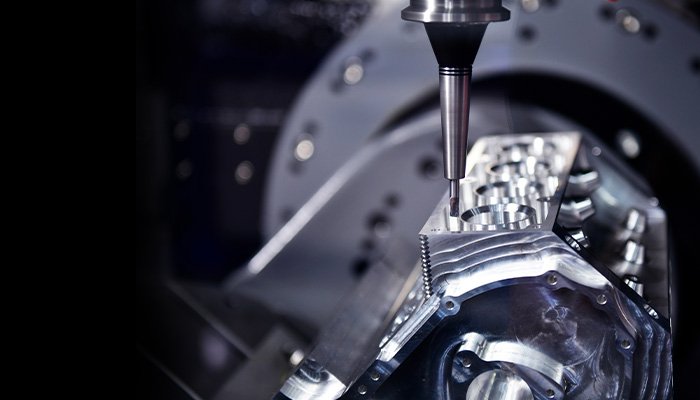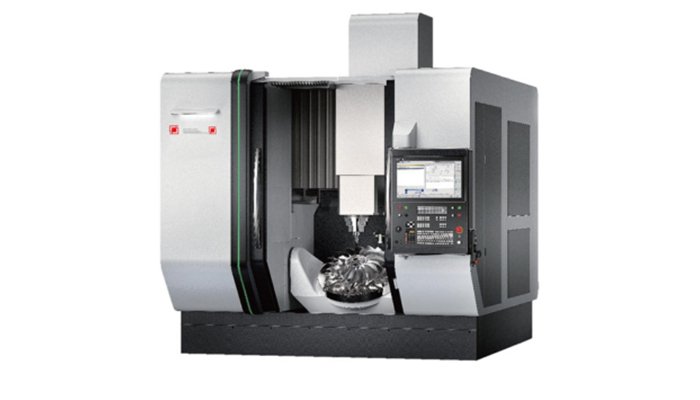
When you are planning to invest in a CNC machine, knowledge of what a machining center is will assist you in making excellent choices.
A machining center is a precision powerhouse that takes raw materials and turns them into sophisticated components with unparalleled speed.
In the competitive world of manufacturing, selecting the most appropriate machining center may directly influence your productivity, quality, and profits. We will go through all you need to know, and the specifications you have to think of when buying this product.
What is a CNC Machining Center?
A CNC machining center is a computer-controlled manufacturing machine that has the ability to conduct various machining processes. Some of these processes include turning, milling, drilling, boring, reaming, and tapping in one time clamping.
It has automated tools, spindles, and a moving worktable guided by pre-programmed code (G-code). It can cut and shape metals, or composite work pieces with the greatest precision.
Machining centers can be automated and are repeatable and consistent, unlike other traditional machines. This strategically makes them suitable for the manufacture of complex components and other mass productions.
Types of Machining Centers
· Vertical CNC Machining Center
A vertical machining center contains a vertical spindle orientation, making it the best suited for applications where gravity aids in chip removal as well as coolant flush. It is common in working with fine parts, mold manufacturing, and flat surfaces because it is easy to access and is also cheap.
A good example is our vertical 5-axis machining center.
· Horizontal CNC Machining Center
The HMC contains a horizontal spindle orientation such that the chips will drop off the work surface without the need to apply any force to move the chips away. The HMC has an advantage in terms of surface finish and tool wear.
The features of these machines enable them to be used in high-volume production and multi-face machining. This is made possible by the in-built pallet changers and their efficient handling of chips.
You can also review our HMC series horizontal machining center.
· Gantry CNC Machining Center
The gantry machining center is a kind of bridge structure with the spindle in the middle of the two vertical columns.
It has high rigidity and is suitable for large, heavy, or wide work pieces and is typically used in aerospace, mold, and automotive tooling applications.
Classification Based on Axes
· 5-axis CNC Machining Center
A 5-axis machine can move the turning tool or part in five possible directions (X, Y, Z, A, or B and C). It can perform the same operations as a 3-axis and 4-axis machine.
You can use it to machine complex surfaces without having several different setups. It is best suited for aerospace components, medical implants, and any component that has curved geometry or undercuts.
· 4-axis CNC Machining Center
The machine has one additional rotary axis (typically A or B) to the conventional X, Y, and Z axes. This enables it to work around cylindrical components or perform side work on them in an efficient manner. It also limits the concept of manual repositioning by enhancing productivity and consistency in parts.
· 3-axis CNC Machining Center
The simplest of them, 3-axis machines, they can travel on X (left-right), Y (front-back), and Z (up-down) axes. They are suited for simple geometries of parts only and are still quite popular in most job shops and smaller operations, as they are economical.
How the CNC Machining Center Works
· Design Part with CAD Software
The technique starts with the development of a 3D model of the piece on a computer-aided design software. It refers to the dimensions, features, and tolerances of a part as specified by engineers. This model is turned into a pattern of machining. An accurate CAD model guarantees quality output in the machine.
· Use G-code to Program a CNC Machine
When done, the design is read into CAM (Computer-Aided Manufacturing) software, which translates it into G-code that runs the CNC machine. According to the code, each movement is specified: the speed of the spindle, the way of the tool paths, coolant, etc.
Such a program is loaded into the control system of the machining center. It may conduct a dry run to test the design before you begin production.
· Set Up the Work Piece
To avoid movement during machining, the raw material or blank is clamped onto the worktable or a fixture in a secure manner. Zero-point and proper alignment settings are carried out. Precision and surface finish are influenced by the stability of the workpiece directly. The checks are done subsequent to the machine commencing any procedure.
· Choose Tooling for CNC
Turning tools of appropriate size (drills, mills, taps, etc.) are inserted into the Automatic Tool Changer (ATC). They are calibrated on length and diameter and assigned according to the specifications of their respective operations to every tool.
The selection of the right tools guarantees quickness, precision, and an excellent surface finish. The latest machining center is able to stock 20-100 plus tools and in-cycle, greatly improving its efficiency.
· CNC Machining Process
When it is all set, the program starts running on the machine, and it automatically changes the tools according to the requirements. The workpiece is moved by the table or head, and the spindle rotates at pre-set speeds.
The aim is to achieve the long service life of the tools, and to cool the tools by spraying coolant. A clean and efficient operation is achieved through continuous chip evacuation.
· Quality Inspection
After the whole process is complete, its quality can be ascertained using various instruments such as CMMs (coordinate measuring machines), micrometers, or a vision system. Another thing worth noting is that any omissions or deviations on the CAD model, are recorded and corrections are accordingly made on the program.
This procedure ensures that the parts achieve the highest engineering tolerances, with the surfaces attaining the correct specifications. Such parameters are very critical in industries such as the medical and aerospace fields.
Benefits of CNC Machining Center
The use of CNC comes with very many benefits that include:
a. Improved Accuracy
Since you are involved in the production of several parts having the same dimensions, you are assured of the exact same product throughout. This aspect also ensures that there is very minimal waste of material during machining.
b. Repeatability
This is mostly guaranteed by the coded program that is created for specific design machining. It ensures that every part is the same with no compromise in quality across each batch.
c. Reduces Required Production Time
The operator requires very little input to operate the machine since all the required tools are incorporated within the machining center, with the process fully automated. This means a lot of time is saved in setting up, therefore reducing the time per cycle.
d. Low Cost of Labor
The fact that the whole process in the machining center is automated means that there is minimal interaction between it and the operator. This limits the manpower required to operate several machines.
e. They Can Machine Complex Pieces
The design of these machines is in such a way that it can move along two to up to 5 axes, enabling it to cover every machining angle. Such a trait comes in handy, especially in medical devices or aerospace parts where precision is a critical requirement.
Operations Machinists Perform on the Machining Center
· Drilling
Drilling is an operation that forms exact holes in the workpiece with the assistance of a turning drill bit. The CNC machining center promotes uniformity in depth and positioning of the bolt holes, fasteners, and assemblies.
· Tapping
Tapping is the process of milling pre-drilled holes internally. This operation is very crucial, especially in the integration of threaded fasteners.
· Boring
This process enlarges holes that have already been made to have a certain diameter and increases their roundness. It is important that holes are close-fitting to bearings or shafts.
· Reaming
Reaming operations are done to give a super smooth and dimensionally accurate hole, which is usually done in an already drilled hole. You will find its application mostly in dowel pins and precision assembly.
· Milling
Milling involves extraction by turning tools rotating at a higher rate and forming into slots, contours, and surfaces. It is the most all-round operation in the CNC Machining center, and it is used in 2D turning to 3D profiles.
· Grinding
Grinding enhances finishing by an abrasive wheel to smooth surfaces to small tolerances. It is usually the last process that is aimed at producing ultra-smooth surface finishes or hard parts.
CNC Machining Center Specification for Machining Project
· Machine Orientation
This determines the motion of the machine as vertical, horizontal, gantry, or 5-axis simultaneous. It impacts accessibility, chip flow, and part size.
· Number of Machining Axes
Machines with 3, 4, and 5 axes are standard, but with 4 and 5-axis machines, you have rotary motion. The 5-axis machines can process complex multi-angle parts in an all-in-one setup.
· Tool Capacity
Counted in the number of tools that can be accommodated by the machining center (20, 40, 60+). Increased capacity means operations can run without any manual change of tools.
· Spindle Speed
The speed varies depending on the material. More rapid spindles result in rapid turning and delicate finishing.
· Power Requirements
Make sure your shop can supply the power (in kW) required by the spindle and the servos. This is usually a 3-phase electric infrastructure.
· CNC Machine Control System
Operations are handled with the help of systems such as Siemens, Fanuc, etc. Select the system that corresponds to the knowledge of your team and is easily compatible with your software.
· Machine Safety
Make sure to look into the features of emergency stop buttons, interlocks of the enclosures, fire suppression, auto shutdowns, etc. They are very critical in protecting the operator.
Common Applications in Different Industries
· Aerospace
Applied to the machining of turbine blades, airframe, and landing gear using ultra-high precision and preparation of exotic materials.
· Medical
Machining centers manufacture implants, surgical equipment, and components of medical devices that need biocompatible finishes and close tolerances.
· Automotive
Perfect for making engine components, transmission housings, brake calipers, and other components where a low variance is important.
· Electronics
We can use them to make heat sinks and enclosures as well as connectors, particularly of magnesium and aluminum alloys.
· Construction
Assists in the production of construction components, bespoke brackets, and heavy equipment components, which are used in civil engineering structures.
· Oil and Gas
Harsh environment valve body, pump housings, couplings, and flanges are machined using the CNC Machining center.
· Marine
They are used in making propellers, underwater housings, rudder sections, and corrosion-resistant structures.
Conclusion
A machining center is a versatile equipment in the modern part fabrication process. It is for this reason that the machine has been adopted across different industries.
As your advanced machinery manufacturer, Shawahed is popular for its highly precise and robust machine designs for modern machining applications.
FAQ
1. What are the main components of machining centers?
Though they have a sophisticated structure, the major parts include the worktable, a control panel, a spindle, tool magazine and an automatic tool changer.
2. Is there a difference between a machining center and a CNC milling machine?
The major difference between these two is complexity and sophistication, with CNC milling machines having a simple structure. Machining centers are complex with automatic tool changers.
3. What is a CNC machining center used for?
It is used for creating complex part designs using various incorporated processes, such as milling and drilling with extreme precision.
4. How does turning center vs. machining center compare?
The major difference is that while the machining center is “the tool rotates and the workpiece is stationary”; the turning center is “the workpiece rotates and the tool moves”.
5. What are the common defects in machining centers?
The common defect is the usual wear and tear of the tools, in addition to them being misaligned, or work surfaces being uneven.
6. What is a double-column machining center?
Just as the name suggests, its structure has two columns aligned vertically with a cross beam to strengthen it. Commonly used for very large work pieces.