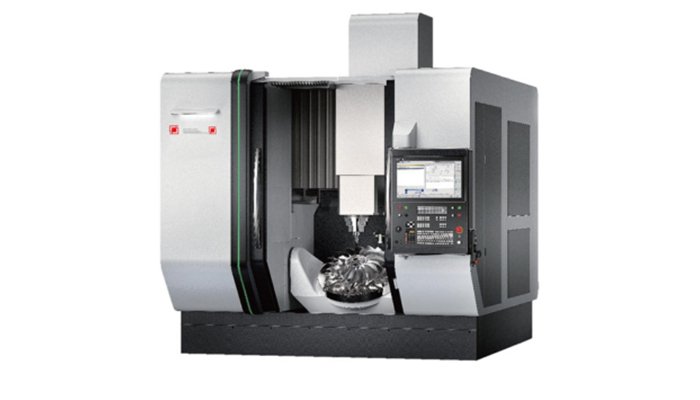
CNC machines work on the principle of turning operations. However, the design of their beds significantly contributes to their accuracy, stability, handling of workpieces, and even production speed.
In this guide, we will explore each of the two types and explain how they differ. This will help you make an informed purchase decision when you are setting up a workshop or factory.
What is Slant Bed CNC Lathe?
A slant bed CNC lathe has an angled lathe bed relative to the horizontal plane. This angle can be either 30° or 45°, depending on your operational requirements.
It is worth noting that this system also arranges the tool turret and spindle so that the chips will naturally fall off due to gravity toward the work area. We can use this machine where precision is critical.
Additionally, it is preferred for high-velocity machining, in which accuracy, rigidity, and automation are paramount. A perfect example of its application is in the aerospace, automobile, and complicated component-producing industries.
What is a Flat Bed CNC Lathe?
A flat-bed CNC lathe machine is configured in such a way that the carriages and tool turret traverse on a plane parallel to the ground. It contains a horizontal bed with a traditional design.
This means that its working envelope is large and therefore, it can handle longer and heavier material pieces. These machines tend to be cheaper, simpler to operate, and maintain.
That is why their application is focused mostly on general machining and repair work. They are also best suited for lower-demand precision operations.
Difference between Slant Bed and Flat Bed CNC Lathe
· Structure and Design
Slant Bed: It is constructed in such a manner that it has a slanted bed, which offers enhanced chip flow and a tighter construction. The inclined geometry provides the operators with better access to the workpiece and tools as well.
Flat Bed: This type of CNC lathe has a horizontal bed, which is suitable for long and large work pieces. It has a simpler, more traditional layout, easy to analyze and use for basic machining purposes.
· Stability
Slant Bed: It provides better rigidity because of its monoblock structure, which is slant cast. This reduces vibration in the course of the high-speed machining operation of the job. The angled design also enables the weight to be distributed more evenly.
Flat Bed: There is good stability, except that stability may be compromised in scenarios where high speeds and deep cuts are to be used. When dealing with very big/heavy parts, greater flexibility can be encountered in the horizontal design.
· Precision
Slant Bed: This type of CNC is renowned for being very precise and repeatable (especially during complicated CNC tasks). Strict tolerances are possible because of the lowered vibration and the rigid structure.
Flat Bed: It is accurate enough to turn most general and larger workpieces. However, it cannot match the levels of accuracy available to the slant bed machines in cases where extreme accuracy is required.
· Mechanism for Chip Removal
Slant Bed: The chips will naturally roll down the angled bed into a collection point, leaving the turning area to remain clean while minimizing the heat-easing potential. This efficient operation increases the tool life and eliminates cleaning downtime.
Flat Bed: The chips build up on the surface of the bed and need periodic cleaning by human means or machine. This may hamper long runs of production and may result in time loss due to cleaning downtime.
· Space Requirement
Slant Bed: You will find a smaller footprint across the same spindle length for this machine, which is made possible due to its slanted geometry. This contributes to it being a preferred choice, especially when you are contending with limited space to conduct your workshop operations.
Flat Bed: This is contrary to the slant bed because it takes more floor space, especially when you are handling longer work pieces. The horizontal format is an expansion of the length of the machine as opposed to a slant bed.
· Handling Workpiece
Slant Bed: Most suited for machining operations on medium-length parts and complex geometries. The angle of the design provides some form of restriction while working with very long handle work pieces.
Flat Bed: Ideal for work pieces with long shafts, pipes, and any other oversized parts. It has a big working envelope, enabling heavy work pieces to be mounted and machined easily.
· Ease of Set Up
Slant Bed: It has more convenient tool access and provides ergonomic positioning of the operator. This assists in minimizing the sense of fatigue during set-ups and tool changes, while its turret inclination enhances viewing.
Flat Bed: The flat layout, along with an increased reach to get items in and out, may be more physically stressful on the operator. This is particularly rife, especially when you are dealing with large work pieces.
· Cost
Slant Bed: In general, it is more costly compared to flatbed CNC since it is designed better, has superior rigidity, and extreme precision capabilities. In many cases, it comes highly recommended for use in establishments with high productivity.
Flat Bed: It is relatively cheaper and very economical, especially if you are dealing with general turnings or repairs. It is appealing to small workshops because of the lower initial investment and the cheap maintenance costs.
· Where to use CNC Lathe
Slant Bed: It works perfectly well when you are dealing with precision manufacturing or high-velocity production. It is also recommended in situations where the part geometry is difficult, and in places where the manufacturing tolerance is narrow and cycle time counts.
Flat Bed: It is the best choice if you have standard repair shops, large work piecing, turning, and making of custom one-off parts. It is also the machine of choice for any industry that does not need ultra-high precision.
Conclusion
Regarding slant bed vs. flatbed CNC lathes, your decision should be based on your workpiece type, need for precision, and budget. Slant beds excel in high-speed, precision applications where chip control, rigidity, and operator ergonomics are essential. Large, heavy work pieces could not be better accommodated by flat beds. Additionally, general machining can also find an economical application in them.
At Shawahed, we have a wide range of CNC machines, including CNC machining centers like the 5-axis CNC machining center, and high–precisions milling machines. For all your CNC lathes, contact us now.
FAQs
What are the advantages of a slant-bed CNC lathe?
Some notable advantages include improved chip evacuation, increased rigidity, added precision, and overall, better operator access.
What are the advantages of a flat CNC lathe?
They cost less to buy, have a larger work envelope on long pieces, fewer problems with heavy work pieces, and a simpler design.
Which is better between a flat-bed CNC lathe and a slant-bed CNC lathe machine?
Neither can be said to be superior in all aspects; slant beds offer accuracy, speed, and chip removal. On the other hand, flat beds are better when a long, heavy piece of work is to be handled and at a lower price.